When you're standing at the paint counter, you've probably been handed a colour chip and asked, "And which sheen are you thinking?" It's a simple question that can send even seasoned renovators into a quiet panic. The difference between eggshell and pearl, or between semi-gloss and gloss, isn't just cosmetic; it affects durability, cleanability, how the light moves across your walls, and how long your paint job actually lasts.
At Cloverdale Paint, we use a consistent sheen numbering system, GL1 through GL7, across our full product line. Once you understand how this ladder works, choosing the right finish for every room becomes straightforward. Here's how to read it.
FIRST: WHAT DOES "SHEEN" ACTUALLY MEAN?
Sheen refers to how much light a dried paint film reflects. It's measured in gloss units (GU) at a specific angle, typically 60 degrees against the wall. The higher the number, the more light bounces back at you. Lower sheens absorb more light, which visually softens a surface and disguises small imperfections like nail pops, uneven plaster, or roller texture. Higher sheens reflect more light, making a surface look crisp and bright, but they'll also reveal every bump and brush stroke if the wall hasn't been properly prepared.
This is why sheen isn't just an aesthetic choice. It's a practical one, driven by traffic, moisture, and the condition of your walls.
"Lower sheens forgive imperfect walls. Higher sheens forgive imperfect cleaning. The art is matching the right one to the right room."
CLOVERDALE PAINT'S SHEEN LADDER: ALL SEVEN LEVELS EXPLAINED
The following guide uses Cloverdale Paint's official GL classification system, with gloss readings taken at 60 degrees as noted on our product labels.
GL1 — Flat / Matte (Mat)
2–4 gloss units @ 60°
The lowest sheen in the range: absorbs almost all light, hiding surface flaws beautifully. Not the most washable, but unmatched for creating a soft, velvety depth of colour. A designer favourite for formal rooms and ceilings.
Best for: Ceilings, formal dining rooms, adult bedrooms, feature walls.
GL2 — Eggshell (Coquille d'œuf)
6–8 gloss units @ 60°
The most popular interior finish in Canadian homes, and for good reason. It has just enough sheen to be wipeable, but still looks soft and non-commercial on the wall. Think of the subtle lustre on the outside of an eggshell; that's exactly what you're getting.
Best for: Living rooms, bedrooms, home offices, low-traffic hallways.
GL3 — Pearl (Perle)
14–16 gloss units @ 60°
Where Eggshell ends and performance begins. Pearl has a noticeably silkier look than eggshell and handles moisture significantly better, which is why it appears as "Satin" on Cloverdale's exterior product labels. It's the workhorse finish for busy households.
Best for: Children's rooms, active hallways, powder rooms, laundry rooms, exterior walls.
GL4 — Low Gloss (Lustre faible)
25–30 gloss units @ 60°
The entry point into the trim family. Low Gloss sits between the wall finishes and the high-performance coating range, slightly shinier than Pearl but with noticeably better hardness and scuff resistance. Often used on interior millwork and built-ins when you want a refined look without a full gloss.
Best for: Millwork and built-ins, cabinetry, interior doors in low-traffic formal spaces.
GL5 — Semi-Gloss (Semi-lustre)
45–50 gloss units @ 60°
The standard choice for trim, doors, and window casings in Canadian homes. Semi-Gloss is hard, moisture-resistant, easy to wipe clean, and bright enough to make architectural details pop against the wall. If you're only choosing one trim finish, this is it.
Best for: Baseboards and trim, interior doors, window casings, kitchens, and bathrooms.
GL6 — Gloss (Lustre)
76–80 gloss units @ 60°
A high-performance, high-reflectance finish for surfaces that take real punishment. Gloss creates a lacquer-like appearance on doors and cabinets and stands up to repeated washing and contact. It demands thorough surface preparation; every imperfection will show, but when done right, it looks exceptional.
Best for: Kitchen cabinets, exterior doors, high-traffic interior doors, commercial millwork.
GL7 — High Gloss (Lustre haute)
85–90 gloss units @ 60°
The highest gloss in the range, used in specialty applications, professional finishing environments, and wherever a near-mirror finish is required. Not typically used for residential walls.
Best for: Specialty applications, furniture and cabinetry (factory finishing), commercial interiors.
A NOTE ON THE NAME THAT TRIPS EVERYONE UP
You'll notice that our GL3 is called "Pearl" on interior products, but the same sheen level is labelled "Satin" on exterior products. This isn't a different finish; it's the same gloss range (14–16 GU @ 60°), just marketed under the name most familiar to exterior painting customers. If a contractor or paint advisor mentions "Satin" for an outdoor project and "Pearl" for indoors, they're referring to the same performance level.
ROOM-BY-ROOM: A DESIGNER'S CHEAT SHEET
Here's how to approach sheen selection for a typical Canadian home: factoring in traffic, moisture, light quality, and the most common surfaces found room by room.
Ceilings (all rooms): Recommended: GL1 Flat
Flat eliminates light bounce and can hide seams. Always use flat on ceilings.
Living room walls: Recommended: GL2 Eggshell
Low traffic, low moisture — eggshell provides a sophisticated, washable finish without looking commercial.
Bedrooms (adult): Recommended: GL1–GL2 Flat or Eggshell
Calm, non-reflective. Flat suits walls in good condition; eggshell if you want easier cleaning.
Children's rooms: Recommended: GL3 Pearl
Crayon, handprints, and scuff marks are unavoidable. Pearl wipes clean far better than eggshell.
Hallways and mudrooms: Recommended: GL3 Pearl
The highest-traffic walls in your home. You need the durability and cleanability that pearl delivers.
Kitchen walls: Recommended: GL3–GL5 Pearl to Semi-Gloss
Splatter, grease, and steam demand a washable finish. Pearl for upper walls; semi-gloss near cooking areas.
Kitchen cabinets: Recommended: GL5–GL6 Semi-Gloss or Gloss
Cabinets take daily contact and need a hard, wipeable film. Semi-gloss is standard; gloss for a lacquered look.
Bathroom walls: Recommended: GL3–GL5 Pearl to Semi-Gloss
Moisture resistance is the priority. In powder rooms, pearl is fine; in full bathrooms, step up to semi-gloss.
Trim, baseboards, and casings: Recommended: GL5 Semi-Gloss
The default trim finish across Canada for good reason. It's bright, crisp, scuff-resistant, and easy to touch up.
Interior doors: Recommended: GL5 Semi-Gloss
Doors are touched constantly. Semi-gloss handles it. Use gloss only when you want a statement door.
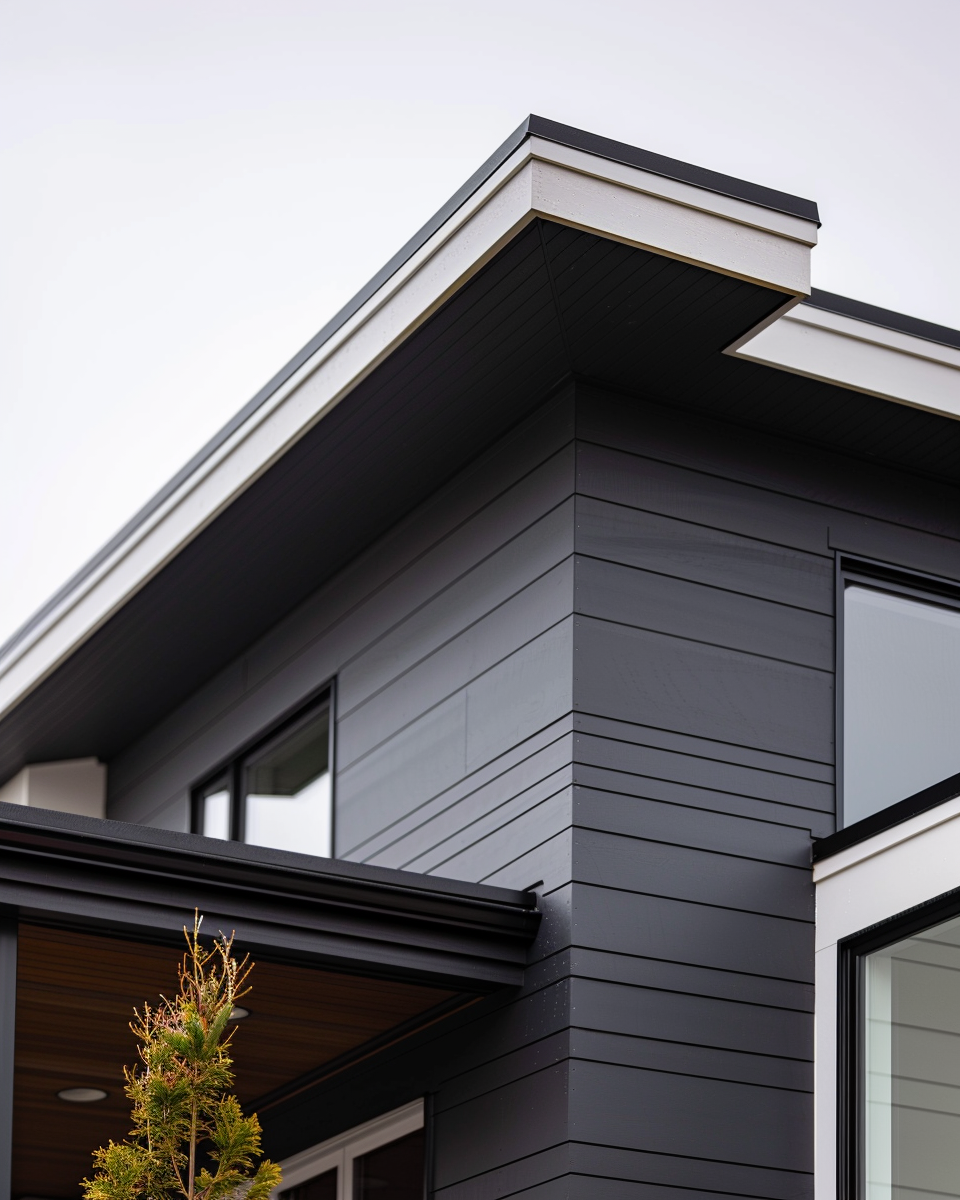
Exterior siding: Recommended: GL3 Satin (Pearl)
Satin is the standard exterior wall finish, flexible enough for Canada's freeze-thaw cycles, resistant to mildew and UV fading.
Exterior doors and trim: Recommended: GL5–GL6 Semi-Gloss or Gloss
Curb appeal and durability. A gloss front door makes a strong design statement and is easy to wipe clean.
Designer's note on sheen contrast:
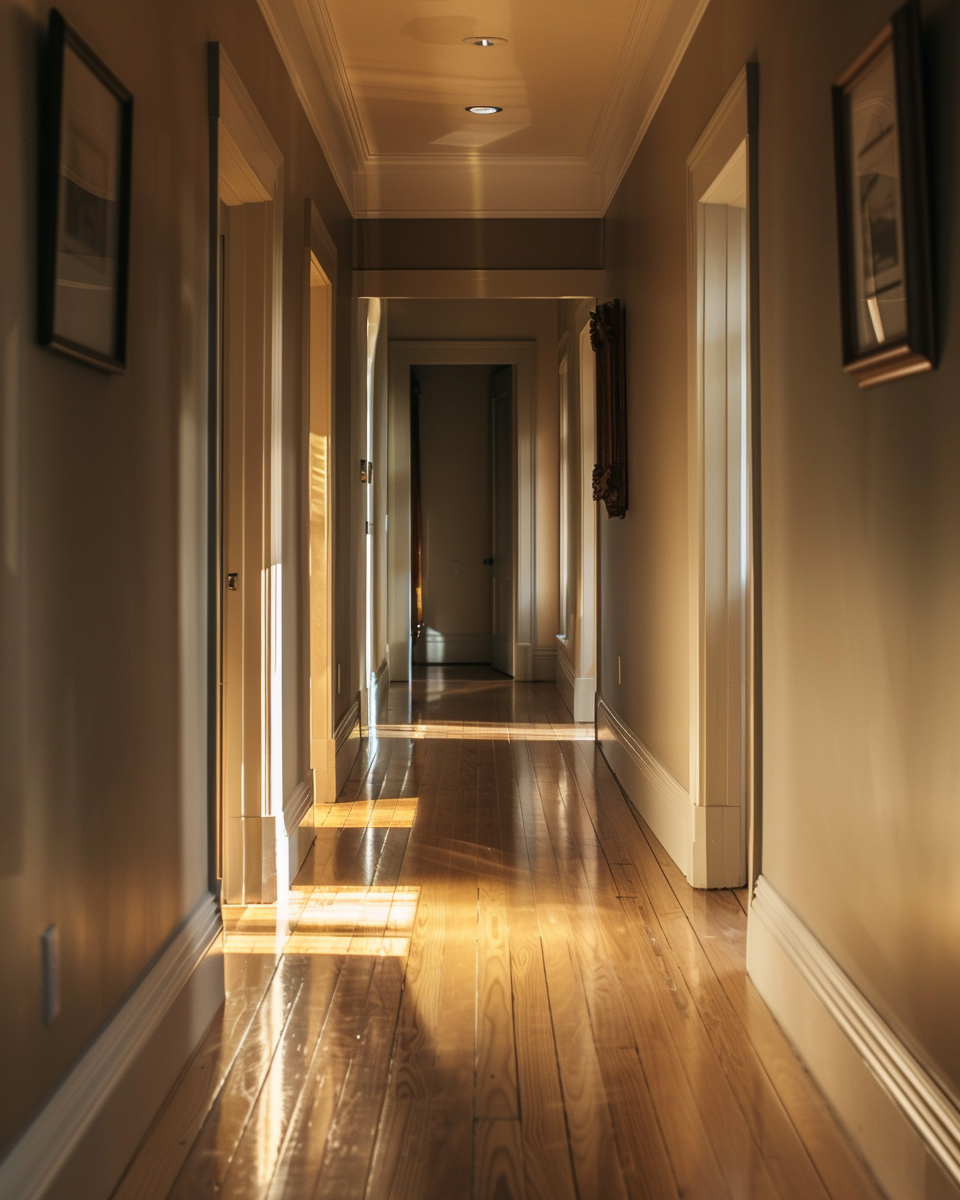
One common design technique is to paint your walls in Flat or Eggshell, then apply the same colour but in Semi-Gloss on the trim. The result is a subtle tonal contrast that gives the room a finished, layered quality without introducing a second colour. It's particularly effective in hallways and bedrooms where you want the architecture to read clearly without visual noise.
WHAT SHEEN CAN'T FIX — AND WHAT IT CAN
A common mistake is choosing a higher sheen to solve a surface problem. If your walls are rough, uneven, or poorly patched, gloss paint will not smooth them out; it will make every imperfection more visible. Sheen affects how light interacts with the film, not the texture underneath it.
If you're dealing with rough walls or textured ceilings, your best tool is a flat finish paired with proper surface preparation, filling, sanding, and priming. Once the surface is right, the sheen choice is purely about performance and look.
Conversely, sheen can genuinely transform the performance of a painted surface. A hallway painted in eggshell will start to show grimy marks within a year of heavy use. The same hallway in Pearl will wipe clean season after season. The right finish protects your investment in the paint job itself
THE ONE SHEEN MISTAKE ALMOST EVERYONE MAKES
Using the same sheen on walls and trim. It's an easy shortcut: buy one sheen, apply it everywhere, but the result is a flat, undifferentiated look that makes a room feel unfinished. Architecturally, trim exists to define and frame a space. When it's painted as the same sheen as the wall behind it, it disappears into the background.
The traditional separation is: low sheen on walls (GL1–GL3), higher sheen on all woodwork and trim (GL4–GL6). This contrast is what gives a professionally painted room its clean, resolved quality.
FREQUENTLY ASKED QUESTIONS
Q: What is the difference between Eggshell and Pearl paint finishes?
Eggshell (GL2) measures 6–8 gloss units and has a very soft, low sheen, ideal for living rooms and bedrooms where you want a clean, matte-adjacent finish that's still washable. Pearl (GL3) measures 14–16 gloss units and has a noticeably silkier appearance with better moisture resistance. Pearl is the right step up for busier spaces, children's rooms, and anywhere with higher humidity or more contact.
Q: What paint finish should I use in a bathroom in Canada?
For a full bathroom with a shower or tub, use Pearl (GL3) at a minimum, but Semi-Gloss (GL5) is the more common and more protective choice. The higher moisture levels in Canadian bathrooms, combined with cold, dry winters that cause condensation cycling, mean you want a finish with genuine water resistance. For a powder room (no shower), Pearl is perfectly adequate.
Q: Is flat paint the same as matte paint?
In Cloverdale Paint's system, both "Flat" and "Matte" refer to GL1, the lowest sheen level, measuring 2–4 gloss units. The term "Flat" is used on conventional interior products; "Matte" is often used for high-performance flat formulations (HP Flat). The gloss level is identical. Always check the GL code on the label if you're matching products.
Q: Should I use semi-gloss or gloss on trim and doors?
Semi-Gloss (GL5, 45–50 GU) is the standard choice for most Canadian homes — it delivers a clean, bright finish on trim and doors that wipes down easily without demanding perfect surface preparation. Gloss (GL6, 76–80 GU) produces a more lacquer-like appearance and is more durable, but it will clearly show any surface flaws, so walls and trim need to be very well prepared beforehand.
Q: What is Low-Gloss paint used for?
Low Gloss (GL4, 25–30 GU) sits between the wall finishes and the traditional trim range. It's most often used on millwork, built-in cabinetry, and interior woodwork where a designer wants a refined look without the high reflectance of semi-gloss. It's also a good choice for interior doors in formal spaces — living rooms, libraries, studies — where a full semi-gloss would look too commercial.
Q: Does paint sheen affect colour?
Yes, noticeably. Higher sheens intensify the perceived depth and saturation of a colour because the reflective film bounces more light back to the eye. A dark navy in semi-gloss will look richer and more saturated than the same colour in flat. This means that if you're testing paint samples on your wall (which you always should), make sure the sample is applied in the sheen you intend to use — otherwise the final result may look different from what you approved.
CHOOSING YOUR SHEEN AT THE STORE
When you're ready to choose, bring your room dimensions, note the room's function and light exposure, and let your Cloverdale Paint advisor know whether you're dealing with walls in good condition or surfaces that need more forgiveness. The GL level is printed clearly on every Cloverdale product label — it's the most reliable way to ensure you're getting a consistent finish, especially if you're mixing products across a project.
If you're unsure where to start, the most versatile combination for a typical Canadian home interior is: Flat or Eggshell on walls, Pearl in kitchens, bathrooms, and hallways, Semi-Gloss on all trim and doors. That pairing covers the vast majority of residential needs and has been a professional standard for decades.
Our in-store sheen display shows all seven finish levels side by side on the same colour by our Colour Chip twoers, which is the clearest way to understand the difference before you commit.
Find your nearest Cloverdale Paint location at cloverdalepaint.com/store-locations.